The Algorithms Behind Google SEO: What Every Content Creator Should Know
Introduction
In today’s digital world, simply creating content is not enough you need to create content that performs. Search engines, especially Google, have evolved far beyond basic keyword matching. They now rely on advanced algorithms powered by artificial intelligence, user behavior, and content quality signals to determine what ranks at the top.
For anyone building a portfolio website or working in digital marketing, understanding these algorithms is crucial. Not to manipulate them, but to align your content with what search engines and more importantly, users actually want.
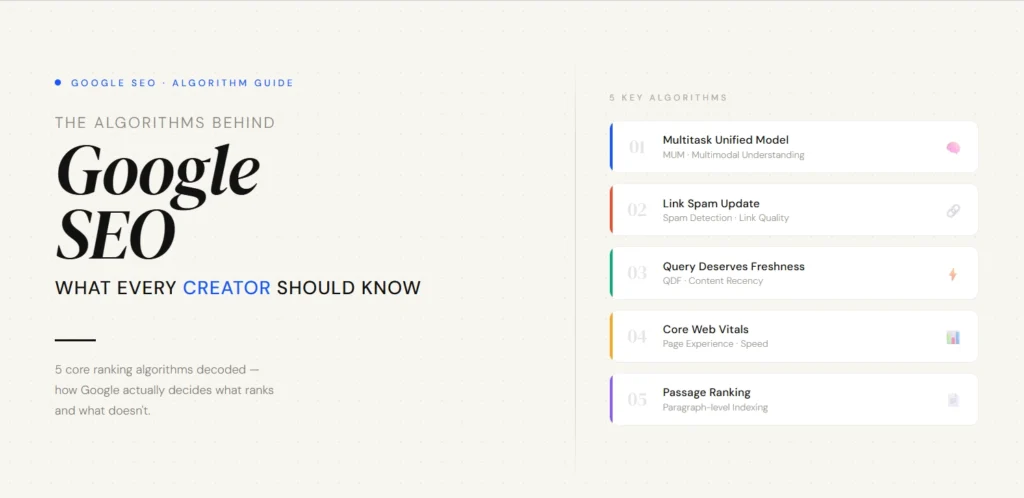
In this blog, we’ll break down five key systems that play a major role in SEO optimization: Multitask Unified Model (MUM), Link Spam Update, Query Deserves Freshness (QDF), Core Web Vitals, and Passage Ranking.
- Multitask Unified Model (MUM): Understanding Search Like a Human
The Multitask Unified Model (MUM) represents a significant leap in how Google understands search queries. Unlike older systems that focused mainly on keywords, MUM can process information across multiple formats, including text, images, and even different languages.
This means Google can now interpret complex queries more like a human. For instance, a search like “best way to prepare for a marathon in a humid climate” will trigger results that combine training plans, hydration tips, and climate-specific advice even if those exact phrases aren’t used together.
Why it matters:
– Encourages deep, topic-focused content
– Rewards context and clarity
– Reduces dependency on exact keyword usage
To optimize for MUM, think beyond keywords and focus on delivering complete, meaningful answers.
- Link Spam Update: Prioritizing Authentic Authority
Backlinks have long been a cornerstone of SEO, but not all links are created equal. The Link Spam Update ensures that only genuine, high quality backlinks contribute to your website’s authority.
This system identifies and neutralizes manipulative practices such as:
– Buying backlinks
– Using link farms
– Excessive link exchanges
Instead of heavily penalizing sites, Google often chooses to ignore spammy links, making them ineffective.
Best practices:
– Earn links through valuable content
– Collaborate with relevant, credible sources
– Focus on long-term authority building
Authenticity is now the foundation of link building success.
- Query Deserves Freshness (QDF): Staying Relevant in Real Time
The Query Deserves Freshness (QDF) algorithm determines when users are looking for the most up to date information. It is especially important for time-sensitive topics like news, trends, or rapidly changing industries.
For example, searches related to new technology updates or current events will prioritize recently published content over older articles.
How to leverage QDF:
– Regularly update existing content
– Publish on trending topics quickly
– Include recent statistics and insights
Freshness signals relevance, and relevance drives rankings.
- Core Web Vitals: The Importance of User Experience
SEO is no longer just about what you say it’s also about how your website performs. Core Web Vitals focus on user experience by measuring three key aspects:
– The rate at which your content loads
– Interactivity: The speed at which visitors can engage with your website
– Visual Stability: The layout’s level of stability during loading
A slow or poorly optimized website can negatively impact rankings, even if the content is excellent.
Optimization tips:
– Optimize media and reduce image size
– Make use of dependable and quick hosting
– Ensure mobile responsiveness
A seamless user experience keeps visitors engaged and signals quality to Google.
- Passage Ranking: Every Section Matters
The Passage Ranking system allows Google to rank individual sections of a webpage instead of evaluating only the entire page. This means even a small, well written paragraph can rank highly if it directly answers a user’s query.
For example, a long form blog about digital marketing might rank for a specific section explaining SEO basics, even if the overall topic is broader.
How to optimize for passage ranking:
– Use clear headings and subheadings
– Write focused, concise paragraphs
– Answer specific questions directly
Think of each section as an opportunity to rank independently.
Conclusion
SEO in the modern era is driven by intelligence, relevance, and user experience. Systems like MUM, Link Spam Update, QDF, Core Web Vitals, and Passage Ranking are designed to ensure that users receive the most helpful and accurate information possible.
For content creators and digital marketers, the takeaway is simple:
> Focus on quality, clarity, and value not shortcuts.
When your content genuinely helps users, is technically sound, and stays relevant over time, it naturally aligns with Google’s algorithms.
By understanding these systems and applying them strategically, you can build a portfolio that not only looks impressive but also performs exceptionally in search rankings.